
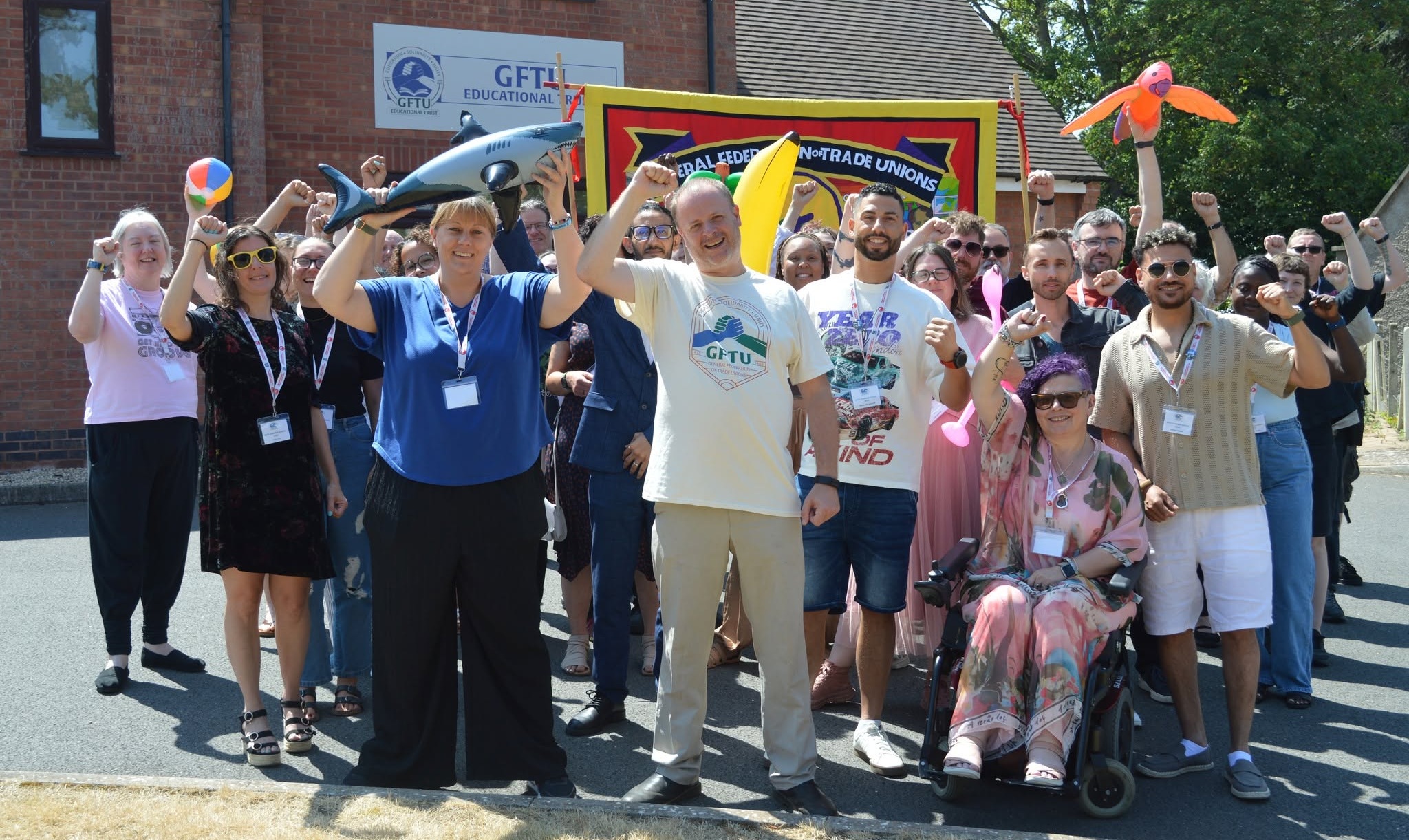
SWU Executive Committee Member Edith Till reports on the 2-day GFTU Summer School course which taught dozens of workers radical political economy, organising skills, and lessons from our history for today.
Day 1
Class Struggle Unionism
GFTU General Secretary Gawain Little explored different approaches to trade unionism and examined where trade union power comes from. He compared partnership, institutional and class struggle approaches, highlighting the strengths and limitations of each.
He emphasised that lasting trade union power comes from organised workers acting collectively. The session explored solidarity, workplace organisation and collective action, alongside the challenges created by anti-union legislation and restrictions on industrial action.
Union Maps: How Strong Is the Movement Where You Live? / The 1926 General Strike
Author and activist Callum Cant examined how the strength of the trade union movement can be measured, looking beyond membership numbers to participation and wider social support. He encouraged participants to think about how union power can be mapped and understood at a local level.
The session also explored the history of the 1926 General Strike and its roots in earlier working-class struggles. Callum reflected on the relationship between organised labour, employers and the state, and discussed lessons that remain relevant for trade unionists today.
Why Do Billionaires Exist?
GFTU Educational Trust Knowledge Transfer Partnership AssociateHwanhee Bae explored how extreme wealth is created and maintained within modern capitalist economies. She focused on the difference between earning income through work and accumulating wealth through ownership of assets, investments and businesses.
Using examples from major corporations and financial markets, he explained how wealth becomes concentrated among a small number of individuals. The discussion encouraged participants to think critically about economic inequality, ownership and power.
Understanding and Organising Not-for-Profits
Activist, author, and senior lecturer in Political Science at San José State University Dr Robert Ovetz discussed the realities of working in the non-profit sector and the challenges many workers face, including burnout, insecurity, excessive workloads and poor leadership. Participants reflected on how commitment to a social cause can sometimes be used to justify poor treatment.
He stressed that non-profit workers are workers first and foremost. The session highlighted the importance of organisation, workplace inquiry and collective action in improving conditions and building worker confidence.
Iron Ladies Film Showing and Discussion
Chair of the North Staffs Miners’ Wives Action Group Rose Hunter shared her experiences of the miners’ strike and reflected on the important role played by women, families and communities. She described the challenges faced by mining communities and the solidarity that emerged throughout the dispute.
The discussion highlighted how women organised support networks, raised funds and sustained families during industrial action. Rose encouraged participants to learn from these experiences and apply similar principles of solidarity in their own organising.
End of Session Reflection
Medway Trade Union Council delegateEd Baldwin reflected on the themes raised by the film and linked them to his own experiences during the Royal Mail dispute. He spoke about dismissal, reinstatement and the personal impact industrial disputes can have on workers and their families.
His reflections reinforced the importance of collective support, resilience and solidarity. He highlighted how trade union values remain essential when workers face challenges in the workplace.
Day 2
Organising Game Workers in a Time of AI
Chair of the King’s College London UCU branch Jamie Woodcock and secretary of the IWGB Game Workers branch Jordan Garland explored organising within the video games industry, focusing on job insecurity, outsourcing, layoffs and the impact of artificial intelligence. They explained why increasing numbers of workers are looking towards collective organisation.
The session highlighted practical organising techniques, including workplace mapping, relationship building and identifying shared concerns. They emphasised the importance of developing trust and confidence before launching public campaigns.
Why Won’t Our Economy Grow?
Hwanhee Bae examined the reasons behind slow economic growth despite advances in technology and productivity. He explored financialisation, wealth concentration, housing speculation and the influence of global financial markets.
The session encouraged participants to think about economic decisions as political choices rather than purely technical issues. He argued that organised workers have an important role in shaping future economic priorities.
Using a Worker’s Inquiry to Build Power
Dr Robert Ovetz introduced the worker’s inquiry as a practical organising tool that helps workers understand how their workplaces operate. He encouraged participants to analyse workplace structures, management systems, technologies and supply chains.
By building a deeper understanding of the workplace, workers can identify opportunities for action, develop effective strategies and strengthen collective organisation.
Using the Media
Former industrial correspondent Polly Smythe shared practical guidance on working with the media, handling interviews and communicating trade union messages effectively. Drawing on her experience as a labour journalist, she discussed how media coverage can influence public understanding of workplace campaigns.
She encouraged participants to engage confidently with journalists, develop clear messages and use media strategically to build support for workers and trade union campaigns.
Salting: What Is It? Does It Work?
Jamie Woodcock and Jack Ran explained the organising practice known as salting, where organisers take jobs in non-union workplaces to help workers build organisation from within. They discussed examples from organising campaigns in sectors such as retail and hospitality.
The speakers emphasised that successful salting depends on trust, credibility and relationship building. The session highlighted the importance of patience and long-term organising when developing workplace power.
Interested in learning more?
You can read reports of this action-packed course in the Morning Star written by GFTU President & BFAWU General Secretary Sarah Woolley and GFTU Assistant General Secretary Henry Fowler:
- Introduction: https://morningstaronline.co.uk/article/years-summer-school-bringing-heat
- Day 1: https://morningstaronline.co.uk/article/power-labour-movement-history-and-strategies-today-show-us-how-change-world
- Day 2: https://morningstaronline.co.uk/article/organising-skills-building-confidence-and-uniting-our-fights-win
Did you know that SWU members can access the majority of the GFTUET Education Programme training courses free of charge?
The GFTU Educational Trust continues to provide invaluable support to affiliated unions like SWU through leadership development, organising support, solidarity work, and a wide range of educational programmes. This includes activist training opportunities, collaborative projects with academic institutions, and the highly regarded GFTU Summer School and Young Members’ Development Weekend.
Course are delivered in a variety of formats – both online and in-person. Residential courses include all meals and overnight stays, and are run at the state-of-the-art education centre at Quorn Grange in Loughborough. These residential courses create the space to step away from the pressures of work, reflect, exchange ideas and think collectively about how to strengthen workplace organisation and branch activity. Learning alongside others over several days builds stronger relationships, deeper understanding and greater confidence.
The 2026/2027 Education Programme is especially exciting with almost 90 courses to choose from and we encourage our members to take a look!
You can click here to view a full list of courses, click here for a PDF version of the full timetable of courses, or visit the SWU website: https://swu-union.org.uk/gftu-training