
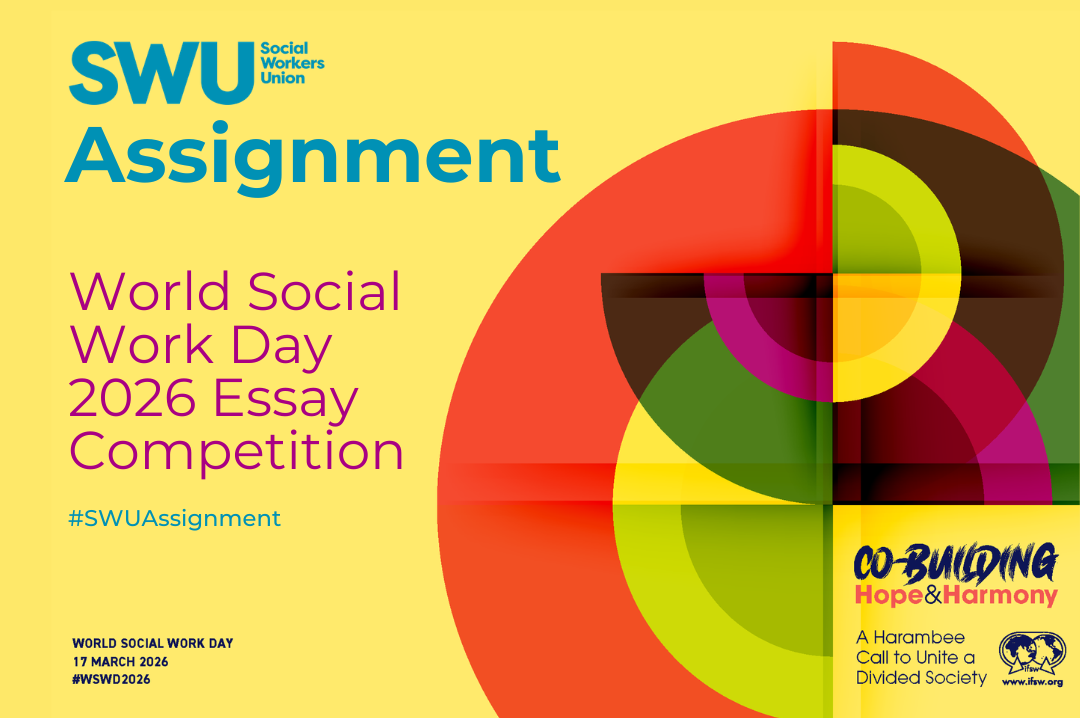
Four social work students / apprentices have each won a prize of £500 for their outstanding essays.
Congratulations to Keleigh Smalley-Willows of the University of Lincoln, Mercy Akinfolurin of the University of Hertfordshire, Judith Nkwopara of Cardiff University, and Laura Barr of Queen’s University Belfast who wrote the winning essays!
The SWU Assignment: World Social Work Day 2026 question was:
“How can the social work profession push back against far-right narratives of division, and how can social workers co-build solidarity and hope across communities?”
This annual competition is open to all Social Work Students undertaking an Undergraduate or Post Graduate Social Work Degree in the UK, Social Work Apprentices, and students undertaking specialist pathway routes. Each winning entrant will receive £500.
John McGowan, SWU General Secretary, highlighted the importance of recognising and celebrating the voices of the next generation of social workers:
“Thank you to all the social work students and apprentices who participated in the competition this year and shared their reflections, insights, and hopes for the future. Your contributions have demonstrated not only your commitment to the profession but also your passion for making a positive difference in the lives of individuals, families, and communities. We are grateful for your participation and look forward to seeing the impact you will make throughout your careers.”
The 2026 SWU Assignment was marked by a Panel including:
- Ann Marie Hayes – a registered Social Worker who is also qualified as a systemic psychotherapist and sits on the SWU Executive Committee
- Narinder Sidhu – an experienced Social Worker with a strong clinical background spanning forensic mental health, CAMHS, brain injury rehabilitation, higher education, and adult social care
- Allison Hulmes – a Welsh Romani social work academic, activist and co-founder of the Romani & Traveller Social Work Association and sits on the SWU Executive Committee
Click here to download the four winning essays as a PDF.
You can also click here to meet the markers for the 2026 SWU Assignment and read the winning essays from previous years at the bottom of the SWU Assignment webpage.
Thank you to our panel of markers.
Ann Marie Hayes said:
“As a marker for this year’s SWU Assignment essays, I was heartened by the depth and courage students brought to a genuinely difficult question addressing how the social work profession can push back against far-right narratives of division and co-build solidarity and hope across communities. The strongest essays resisted easy answers by grounding theory in real communities and lived experience. They demonstrated a willingness to sit with real tension, and were able to hold empathy for genuine grievance alongside a firm refusal to excuse discrimination, all whilst naming power as something social workers must reckon with in their own practice, not just in the systems around them. I would like to thank each writer for engaging so thoughtfully with a question at the very heart of what this profession is for; there is real hope in a cohort of future social workers already thinking this clearly about solidarity, hope, and justice before they’ve even qualified. The work continues.”
Narinder Sidhu said:
“The winning essays stood out because they answered the question with real insight, intelligence and compassion. They clearly understood the role social workers can play in challenging far-right narratives of division, while also showing strong practice knowledge about building trust, inclusion, solidarity and hope within communities. They were all a delight to read, and it was inspiring to step into the thinking of students who are engaging so thoughtfully with the future of social work.”
Allison Hulmes said:
“I was genuinely impressed by the outstanding quality of this year’s essays. Students responded to the question with insight, compassion, and courage, demonstrating strong academic skills and a deep commitment to the values of social work. What stood out was their ability to engage critically with difficult issues while offering hopeful, practical ideas for building solidarity across communities. Choosing a winner was no easy task given the exceptionally high standard throughout. My sincere thanks to everyone who took part. Your thoughtful contributions made this a rewarding and inspiring experience and gave me great confidence in the future of the profession.”
Winning quotes from the four winners:
Mercy Akinfolurin of the University of Hertfordshire said:
“I’m genuinely thrilled and honoured that my essay has been selected as one of the winning entries. The topic matters deeply to me because social workers have a vital role in challenging division, protecting dignity, and helping communities see one another as partners rather than threats. My essay argues that hope is not passive, it is built through everyday practice, honest conversations, solidarity, and collective action. I’m grateful that this message will reach a wider audience and hope it encourages meaningful reflection and positive change.”
Laura Barr of Queen’s University Belfast said:
“I am thrilled to be one of the winners of this year’s essay competition. This year’s topic resonated deeply with me, having worked with a number of minority families during the recent race related riots across NI, and witnessing first-hand the impact and disruption of this on their lives. These experiences have strengthened my belief in the importance of social work as a profession in helping protect and support such individuals.”
Judith Nkwopara of Cardiff University said:
“Winning this competition is deeply meaningful to me. When I submitted my essay, I was still an asylum seeker whose social work placement had been suspended because of my immigration status. The topic was not simply academic, it reflected my lived experience of exclusion and strengthened my belief in the importance of solidarity, hope and anti-oppressive practice. I hope this recognition encourages social workers to continue challenging division and building more inclusive communities.”
Keleigh Smalley-Willows of the University of Lincoln said:
“To be in the top four feels incredibly affirming, as a social work apprentice and a neurodivergent practitioner. My assignment explored how social workers can challenge far right narratives and build solidarity and hope across communities. These issues shape everyday practice; they’re part of the conversations we navigate daily. I wanted to show that social work is strongest when we speak up, act ethically, and embrace diverse ways of thinking, connecting and understanding the world. Social workers cannot be neutral in the face of injustice. Again, can I say thankyou to SWU and the panel for the opportunity and result.”
Social work students and apprentices, be sure to check back next year for the announcement of the 2027 SWU Assignment question on World Social Work Day – March 18th!

Download your free copy of the Reflective Supervision: A Best Practice Guide: https://swu-union.org.uk/resources-training/swu-bnu-reflective-supervision-best-practice-guide-2024
This free guide has been developed by the Social Workers Union and Buckinghamshire New University for social workers, by social workers. It demonstrates the steps which should (and can) be taken within a reflective supervision session and contains best practice guidance for social workers receiving reflective supervision, and those facilitating the supervision session.
You can also find more free resources and information on the SWU website here: https://swu-union.org.uk/resources-training/swu-leaflets-and-information