
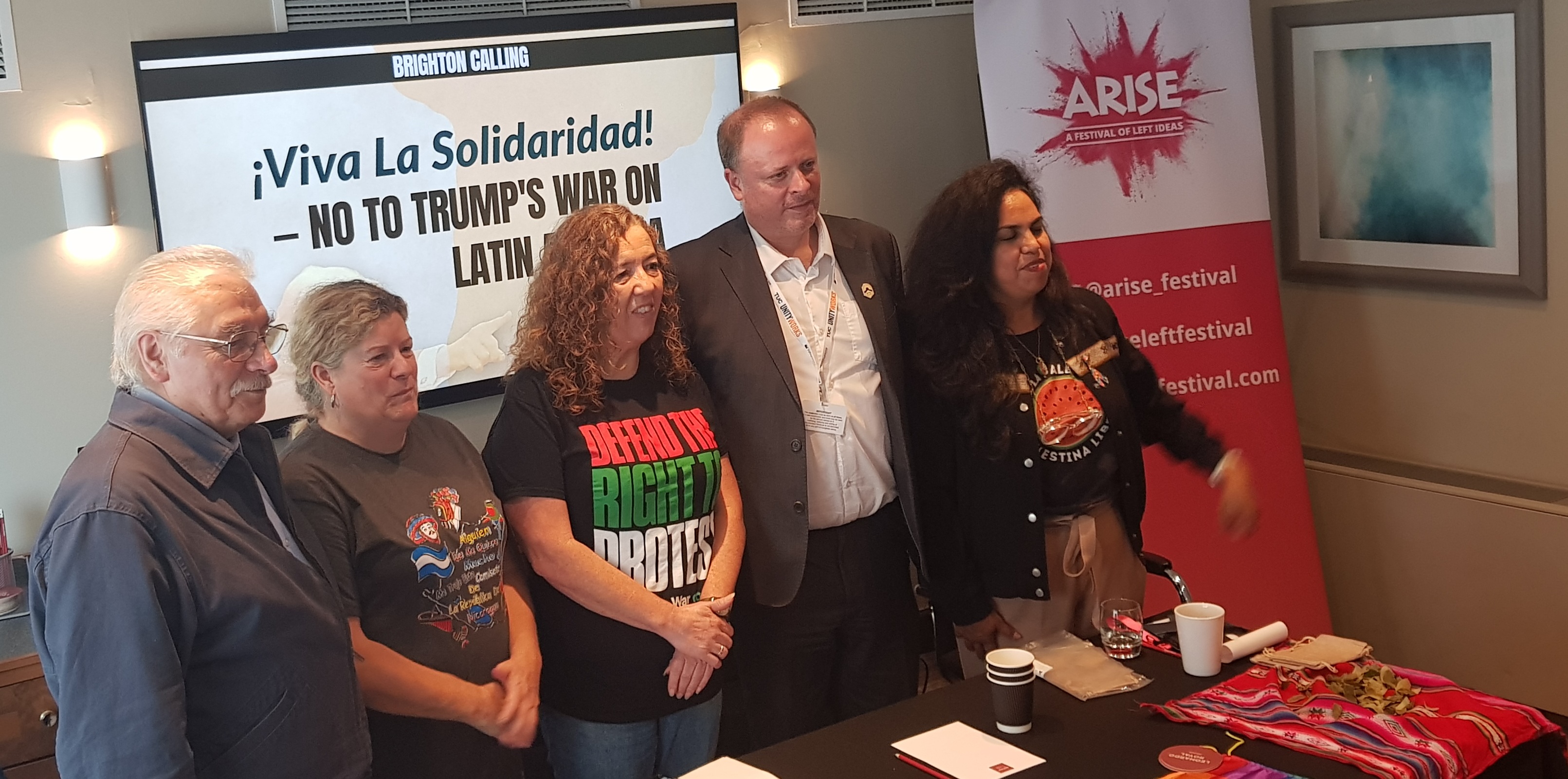
From left to right in the photo above: Venezuela Solidarity Campaign’s Francisco Dominguez, NEU member Natasha Witham, PCS General Secretary Fran Heathcote, GFTU General Secretary Gawain Little, and Wihalas Across the World campaigner Claudia Turbet-Delof
The opening Latin America solidarity fringe meeting, held on 13 September 2026 alongside TUC Congress 2026 in Brighton, brought together trade union leaders and campaigners to discuss international solidarity, democracy, social justice and the challenges facing progressive movements across Latin America.
The event was hosted by Gawain Little, General Secretary of the General Federation of Trade Unions (GFTU), who welcomed delegates and emphasised the importance of international solidarity and the responsibility of trade unionists to stand alongside workers and communities facing injustice and external interference.
Sarah Woolley, General Secretary of the Bakers, Food and Allied Workers Union (BFAWU), argued that international solidarity must remain at the heart of trade unionism. She stated that trade unionists cannot remain silent when workers are exploited, democratic rights are undermined or people are denied the right to determine their own future. Woolley warned against increasing political, economic and military intervention in Latin America and emphasised the importance of respecting national sovereignty, democracy and international law. She also highlighted the role of multinational corporations and global supply chains, arguing that the struggles of workers in Latin America are closely linked to those of workers in Britain and elsewhere.
Francisco Dominguez, National Secretary of the Venezuela Solidarity Campaign, spoke about the continuing pressures facing Latin American countries, particularly those pursuing independent political and economic paths. He criticised sanctions and interventionist policies directed at countries such as Venezuela and Cuba and argued that nations have the right to determine their own futures free from external influence. He called for stronger international solidarity between workers, social movements and trade unions and urged delegates to defend national sovereignty and self-determination. In later remarks, he argued that the relative decline of United States global influence could lead to more aggressive policies towards countries such as Cuba and Venezuela. However, he suggested that right-wing governments often struggle to maintain support because they offer little beyond austerity, privatisation and repression. Referring to growing resistance across Latin America, including large demonstrations in Bolivia, he argued that people continue to organise and defend social and economic rights. He concluded by emphasising that solidarity is a two-way relationship and that Latin American movements have historically stood alongside workers’ struggles internationally.
A brief appeal was made by Ben Hayes of Arise: A Festival of Left Ideas, who thanked attendees and supporters and encouraged continued support for the organisations and campaigns involved in building solidarity with Latin America.
Fran Heathcote, General Secretary of the Public and Commercial Services Union (PCS), argued that the United States continues to view Latin America as part of its sphere of influence. Referring to Donald Trump’s “America First” agenda, she criticised sanctions, attempts at regime change and policies that place pressure on countries that do not follow United States priorities. Heathcote argued that many workers across Latin America are experiencing attacks on wages, employment and public services and drew comparisons with earlier neoliberal programmes imposed across the region. She described these policies as part of a wider agenda designed to reverse social and economic gains achieved by working-class people and stressed the importance of maintaining solidarity between British and Latin American trade unionists.
Natasha Witham, Member of the National Education Union (NEU) and participant in a UK teachers’ delegation to Nicaragua, spoke about the importance of international solidarity and people-to-people links with Nicaragua. Drawing on her experience as part of a UK teachers’ delegation, she reflected on the value of learning directly from educators and communities rather than relying solely on media narratives. She argued that solidarity is built through mutual respect, exchange and understanding, and emphasised the importance of supporting the right of people in Nicaragua to determine their own future free from external interference. Natasha highlighted the role that educational exchanges can play in strengthening international relationships and challenging misconceptions about countries facing political and economic pressure.
The final speaker, Claudia Turbet-Delof of Wiphalas Across the World, focused on political developments in Bolivia and the rise of far-right movements. She warned that right-wing leaders increasingly rely on social media, populist rhetoric and misinformation while advancing neoliberal policies that benefit economic elites. Turbet-Delof stressed the importance of defending democratic institutions, Indigenous rights, social protections and constitutional gains achieved through decades of struggle. She concluded by calling for continued international solidarity and cooperation in confronting the growth of the far right and defending democracy, equality and social justice.
Building Solidarity Beyond Borders: A Call to SWU Members to Stand with Latin America
The recent ¡Viva la Solidaridad! No to Trump’s War on Latin America fringe meeting at TUC Congress 2026 highlighted why international solidarity remains an important part of trade union and social justice movements. For members of the Social Workers Union (SWU), the issues raised are not distant political concerns. They are directly connected to the values and principles that underpin social work practice. SWU itself has a strong tradition of supporting international solidarity, peace and human rights campaigns.
Social work is fundamentally a human rights and social justice profession. The International Federation of Social Workers (IFSW) emphasises that social workers have a responsibility to challenge inequality, discrimination, oppression and violations of human dignity wherever they occur. The themes explored throughout the event, including self-determination, social justice, democracy, poverty and resistance to policies that deepen inequality, are therefore highly relevant to social workers. They reflect many of the challenges practitioners encounter daily when supporting individuals, families and communities affected by social and economic disadvantage.
Speakers at the event discussed the impact of economic sanctions, austerity, attacks on public services and threats to democratic self-determination across Latin America. These are issues that social workers understand well. In the UK, social workers see every day how poverty, inequality, insecure housing, poor mental health and social exclusion affect individuals, families and communities. The social and economic policies that shape people’s lives are therefore inseparable from social work practice because they influence the circumstances in which people live, the opportunities available to them and the pressures they face long before they come into contact with services.
International solidarity also reflects SWU’s commitment to peace, human rights, anti-racism and support for vulnerable communities. The union has consistently spoken out on international humanitarian issues and recognised the importance of standing alongside those affected by conflict, displacement and injustice.
Developments across Latin America raise important questions about democracy, social protection, inequality and human rights that resonate far beyond the region. Economic instability, political unrest and social inequality can contribute to migration, displacement and increased humanitarian needs. Social workers often support refugees, asylum seekers and families whose lives have been shaped by these wider global realities. Understanding international issues helps strengthen our ability to advocate effectively, challenge misinformation and promote inclusive communities.
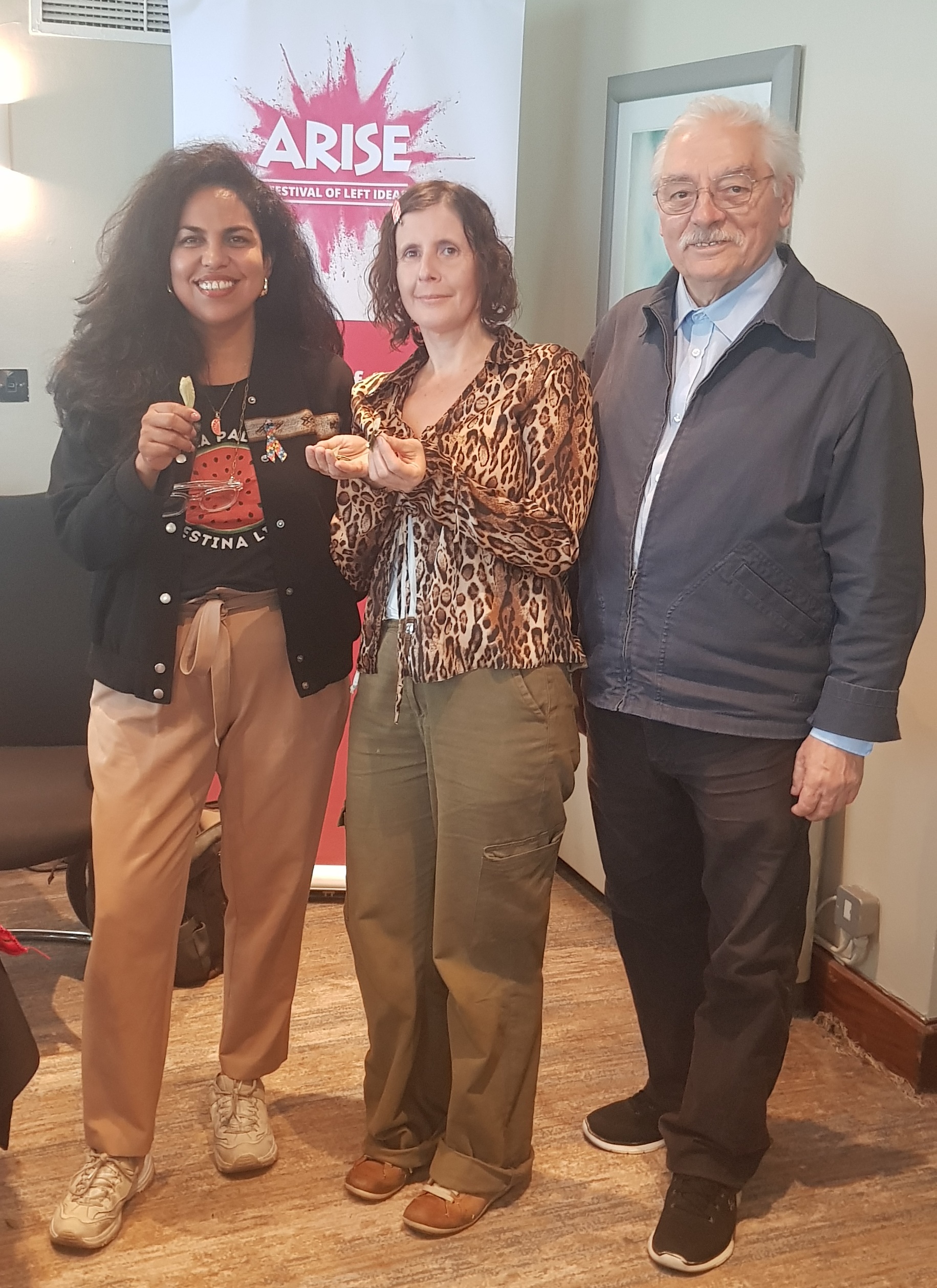
The rise of far-right politics, attacks on democratic institutions and growing social inequality were also themes explored during the meeting. These challenges are not unique to Latin America. Across many countries, including the UK, social workers are witnessing increasing pressures on public services, widening inequalities and growing hostility towards marginalised groups. International solidarity creates opportunities for workers, trade unions and social movements to learn from one another and build collective responses to shared challenges.
Supporting solidarity campaigns is therefore not simply an act of international goodwill. It is social work values in action: human rights, social justice, collective responsibility, respect for diversity, self-determination and challenging oppression wherever it occurs. By standing with workers, communities and social movements across Latin America, SWU members can help amplify calls for democracy, dignity, equality and social protection while building connections with others striving for a more just, peaceful and democratic society. In doing so, we reaffirm that social work’s commitment to human rights and social justice extends beyond national boundaries and contributes to a world where all people can live with dignity, safety and opportunity.
This event report was written by SWU Executive Committee Member Edith Till.
References
- International Federation of Social Workers (IFSW), Human Rights Policy. [ifsw.org]
- International Federation of Social Workers (IFSW), Freedom, Equality, and Justice for All: The Essential Role of Social Work in Advancing Human Rights (2023). [ifsw.org]
- International Federation of Social Workers (IFSW), Human Rights Commission Statements and Resources. [ifsw.org]
- Social Workers Union (SWU), SWU International campaigns and statements. [swu-union.org.uk]
- Office of the United Nations High Commissioner for Human Rights (OHCHR), submission by IFSW on human rights and sustainable development (2025). [ohchr.org]
- How Social Work Upholds Human Rights and Social Justice, Social Work Institute (2025).